Abandoned Farms

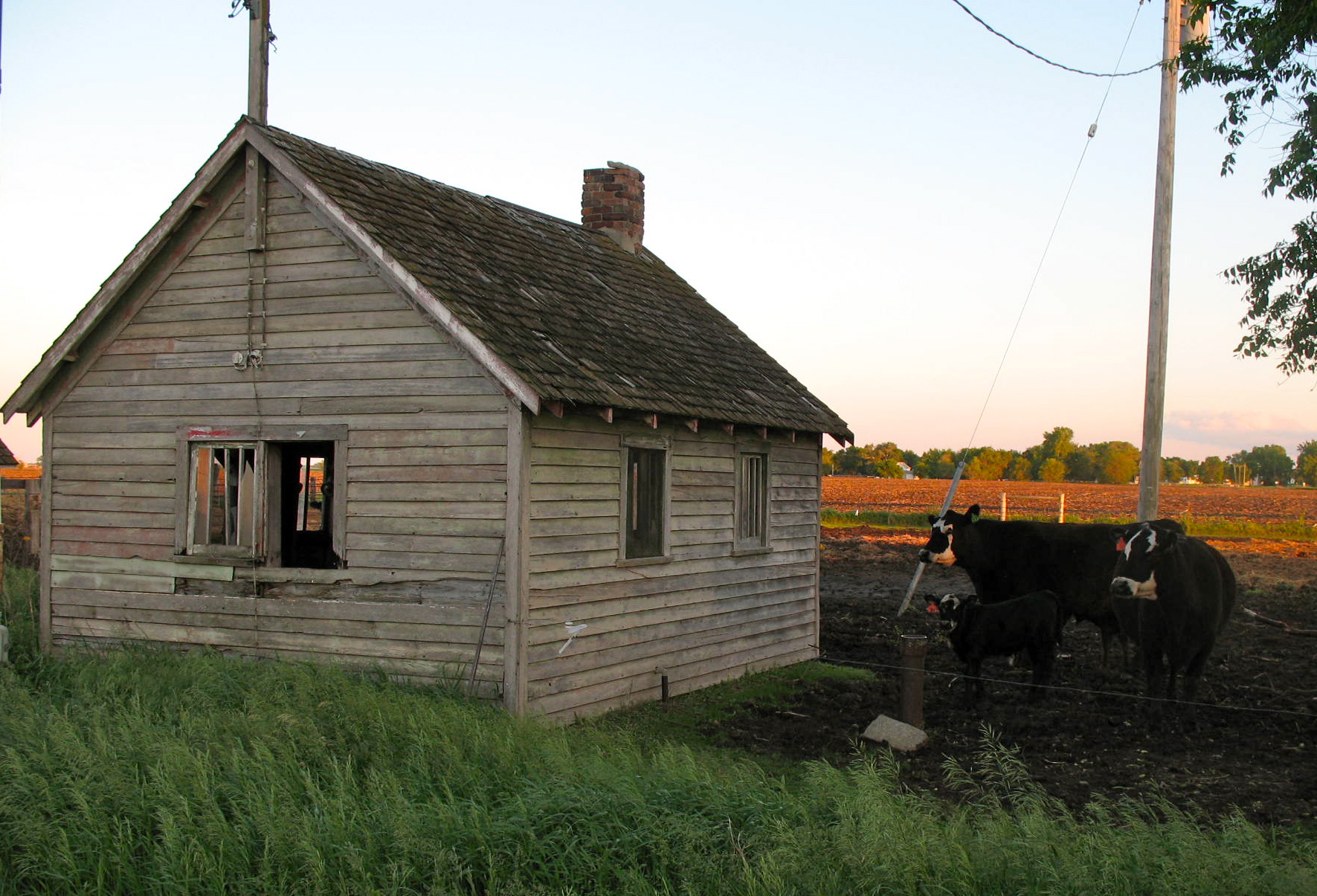
The grass grows up to the foundation, a crumbling remnant of what once was and upon which sits a crooked shamble of  bone dry wood devoid of paint and life.  A front door hangs open, fractured hinges falling forward, trash heaping inside hallow rooms and the life that once was this farm is now gone.

It’s amazing how fast it happens.  A farm is sold – for the land usually – and the house sits empty.  The old houses especially, those built before composite siding and quality paint, compost back into the landscape in a quick succession of years.  A door is left open and the coons and swallows get in.  A tree falls on the roof, punching a hole through so that rain pours in.  Mice invade in droves.

It is sad, for most of these skeletal remains of homesteads could, with a bit of care, have been the future home of the new homesteaders, those urban families looking for a few acres, for the chance to grow their own food and raise a few chickens.

But now they litter the landscape, wooden corpses sinking back into the earth, never to be reclaimed.  They will be bulldozed soon, great piles will rise up.  Dead barns and granaries and homes will be pushed into a great funeral pyre and burned, then buried.

And next year it will all be corn.

Defining Rural Church

One hundred years ago, America was largely a rural nation.  In fact, by some estimates, 90% of the population of the country would have been involved in one way or another with agriculture and with the growing and harvesting of our food.  Today that number has dropped to somewhere between 2% and 5%.

Our country has changed significantly in the last 100 years, not the least of which is our move away from the agrarian ideal.  So too has the church changed, and in particular has the rural church changed.  Kent R. Hunter in his book The Lord’s of the Harvest and the Rural Church published in 1993 defined the rural church this way:

A rural church is a congregation of Christian people who live an agriculturally oriented life-style.  It is a church made up of a people group who belong to the agriculture community.

By Hunter’s definition, I am no longer sure if there is such a thing as a rural church.  When I look at my own congregation I see a changing demographic that can perhaps be categorized into three groups.

  1. Those currently involved in agriculture.
  2. Those who grew up in families involved in agriculture but who are no longer involved in agriculture themselves.
  3. Those who have never been involved in agriculture.

Fifty years ago, group one would have been the majority of the congregation.  Today, group two is the majority and I suspect that in another 20 – 30 years, group three will be the majority.

And so as this shift continues, I wonder if perhaps Hunter’s definition is no longer helpful.  Churches in small, rural locations after all still exist and have far different needs, challenges and opportunities than their urban counterparts.

Is a new definition needed?

I am not one to worry about definitions but I am concerned that we have not fully realized and understood the change that is taking place.  I’d like to continue to explore the topic and will continue to reflect on Hunter’s book as I read.

What I would really like is to see a conversation taking place.

Please feel free to leave your comment and to pass this article on to your rural friends.

You can find The Lord’s of the Harvest and the Rural Church at Amazon. [affiliate link]

Friday Poems: Grey Swept Sky

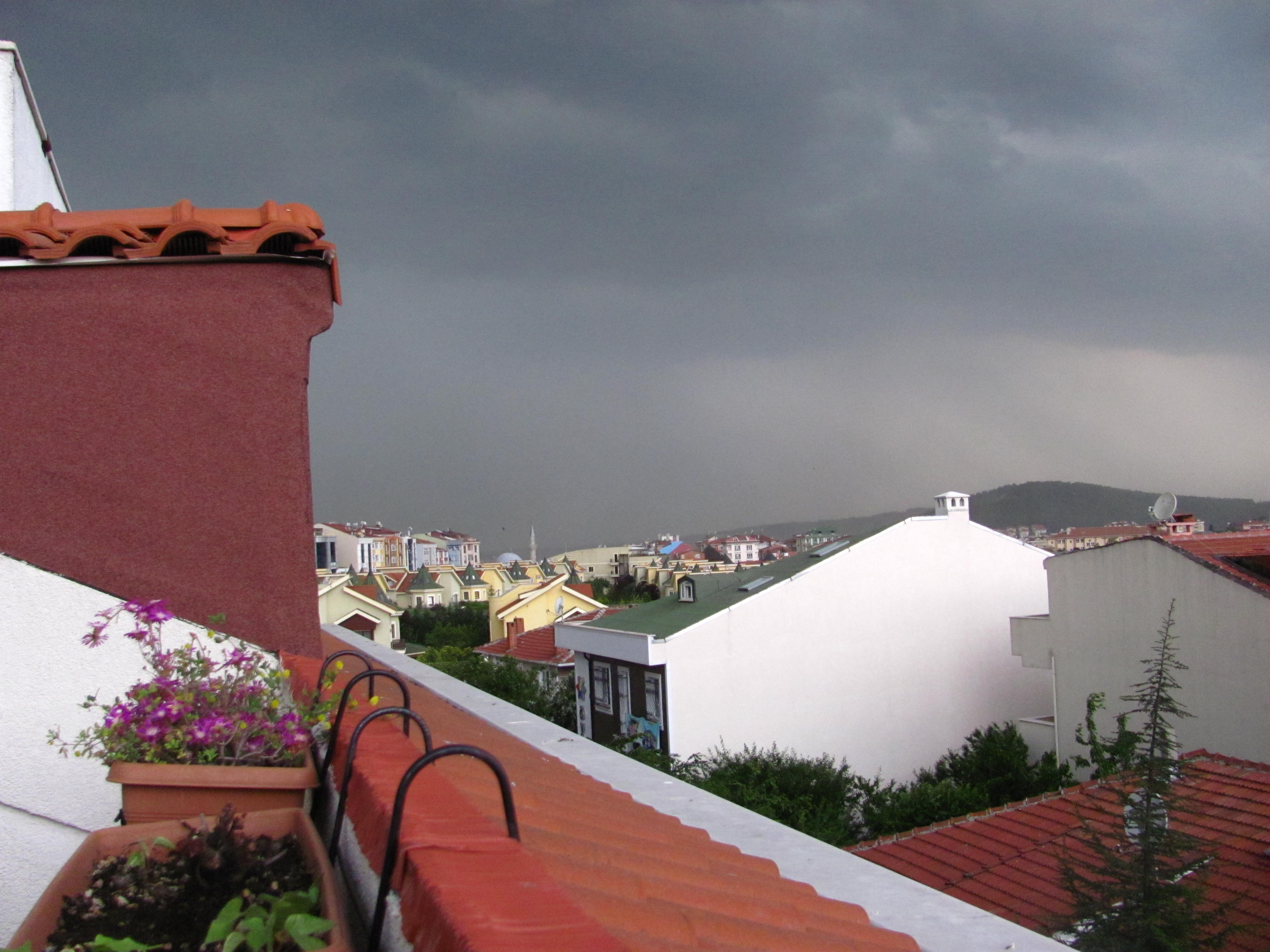
Grey swept skys in Istanbul, Turkey.

Grey swept sky

carries a lonely day

up the steps 

to my backyard.


Clouds come by,

breaking up, coming

again, breaking once more,

then returning with rain.


Lonely day leans with a sigh,

kisses my cheek,

says goodbye–

leaves me with empty remnants

of a once clear day and

of a life gone awry. 

——-

Written sometime in the spring of 2004 in St. Paul, Minnesota.

Why I Use Affiliate Links

If you’ve been following along here at Cobbled Together you will know that one of the topics I wish to write about is my effort to “cobble together” enough income for our family to live on.  For us – at least for now – it’s a little bit here and a little bit there and it’s an adventure to create a life based on our values and our goals for this next season in life.

If you’ve been reading, you will also notice that I often mention something called affiliate links. In today’s post I’d like to take a moment to explain:

  1. What an affiliate link is and how it works.
  2. Why I use affiliate links.

What Are Affiliate Links

Webopedia defines affiliate link in this manner:

In affiliate programs, it’s a special URL that contains the ID or username of the affiliate. This URL is used by the advertiser to track all traffic the affiliate sends to the advertiser’s site as a part of the affiliate program.

Many businesses have affiliate programs.  Amazon Associates is one that I use the most when I write about books but I will also from time promote products from individuals as I did when I wrote about Tent Bloggers Blogging Starter Kit which I also promote on the right sidebar.

The basic gist of these programs is that when someone clicks on a link on my site, a program tells the affiliate program where the new customer came from and then gives a percentage of the sale to me should a purchase be made.

So, if you were to click on one of the book titles in one of my posts, you would be directed to the Amazon sales page.  If you were to purchase that product (or any other product within fifteen minutes), I would get somewhere between 4% and 7% of the sales price.  The price in no way changes for you the customer, I just get a commission so to speak.

While Amazon pays out 4% – 7%, other programs pay out more.  Those hosting their digital products at ejunkie for example pay 50% of the sales price.  This is a great deal for me both as a seller of products and as an affiliate partner for other people’s products.

The aforementioned Blogging Starter Kit is this way for example.  The e-book costs $19.99.  If one of my readers visits and makes the purchase, John over at Tent Blogger would be paid and then would send me 50%  –  $9.99.

As another example, I sell a number of ebooks for language learners from my other site, The Everyday Language Learner.  These ebooks range in price from $2.00 – $20.00 and come as pdf files or bundles of products including pdf files, audio and video files.  In order to streamline the selling and buying process, I host all of my guides at ejunkie, an online store for digital products.  At ejunkie, I also have an affiliate program that you could join.  I too pay a 50% commission.  This works out for me because it gets my products in front of a lot more people.  It is a win-win situation.

Why I Use Affiliate Links

As we returned to South Dakota and as we have laid out a rough vision for what we want our life to look like and what we want to be about, the way forward has led us to not pursue full-time employment working for someone else.

That would leave too little time and energy for accomplishing our goals.

But we still need to earn enough money to pay the bills and feed the kids.  To do that we are working to grow my consultation and writing business online at The Everyday Language Learner, The Turkish Listening Library, Stories from Turkey and Ingilizce Ogrenmek (Learning English).

Income is generated at those sites through the sales of guides for language learners that I have written (you can listen to the audiobook version of my main guide for $3.99 [not an affiliate link]), through Google Adsense and through affiliate links.  Occasional advertizing opportunities also arise and I also offer the Ten Week Journey language course on a donation basis.

I also work as a language coach, which is what I really want to focus on.  This is accomplished over the Internet as well through Skype calls.  Helping people learn languages more effectively, efficiently and to have more fun doing it is what I love to do.

It’s a little bit here an a little bit there and as strange as it seems, it’s working.  Slowly income is growing.

Affiliate links are a part of the overall strategy.   In the old economy it seemed that for every winner there needed to be a loser.  Coca-Cola ran an ad during the nightly sitcom.  They won exposure.  You lost thirty seconds of your time.  Interruption marketing is what Seth Godin calls it.

But with affiliate links, I can write about the things I would naturally write about anyway, things I enjoyed or found helpful, things I would recommend to my friends anyway and irregardless of whether I made a few pennies on it or not.

So that is it. Affiliate links are one part of the quest to pull together a sufficient income to live.  Part of my vocation is that I am a writer.  Affiliate links create a new avenue to leverage that to earn a little bit of money.  Not from you the reader, but from the distributors of products.

Learn More

August 2012 Second Hand Year Report

In my quest to live without buying anything new this year, I’ve decided to document my purchases as much as possible with end of the month round-ups.  This will be the first.

August has been a full month.  The first week found us at a nice debriefing program for expats returning to the states.  It was a great week and really helpful but it was also I think the only time that I broke down and bought anything new for the entire month.  I can’t remember anything else anyway.

The rest of August has been spent back on the farm, recieving the visitations of great friends and now beginning the resettling process.  We’ve made weekly trips to town for food and to visit the library (free books!!!) but I haven’t needed to buy anything really as of yet.

We did start homeschooling the kids and so my wife bought some supplies to get us off the ground.  We also still need to find a place to live but other than that, all is well.

Anyway.  Here is what August looked like as I try and live a second hand life this year.

New Purchases

  • $90.00 worth of books.  Everyone of them has been worth it so far, but had we waited a bit we could have found or ordered used versions of them all I suppose.  Books may be a weakness of mine.  I recently wrote a review of The Lazarus Life which was one of these books.

Second Hand or Free

  • A cell phone.  My mom had an old trac phone which she kindly reformated with a South Dakota number and gave to us for free.  I’ll be working to use it like it’s 1985!
  • TNIV Noteworthy Bible:  $11.00 plus shipping.  I wanted to get a new Bible to start a new season in life and saw someone else’s Bible that had enough space for writing notes and decided I had to have one.  I got this one used from Amazon.  I assume it was purchased and returned or something like that but I ” I’ll see as it’s still on its way.

That is all that I can think for now.  Again, this is just my purchases – it’s my experiment, not my wife and kids.

Anyway, you can see a full run down of the year to date at the Second Hand Year page above.

[some of the links above are affiliate links]

Friday Poems: Out My Window

I wrote this poem as an English teacher at Freeman Academy.  The freshman that year are now juniors in college.

—–

Out my window, rain beats the cottonwood tree from above.

It bows – but it always bows now – and so while it looks as if it is taking a beating,

it is rather enduring as it has for years upon end.

Perhaps when it was young, like my students,

it bowed under the weight of rain, the strength of wind.

Perhaps the year it was planted,

a grandmother of one of my freshmen was a freshmen herself,

was supple and springing and of course,

weak.

And perhaps that grandmother, now bent and bowing is beat on by the rain of life,

but unaffected, strong and resolute.

Perhaps my freshman can watch her and learn to be strong and resolute themselves.

—-

September  2006

Book Review: The Lazarus Life

A good story offers a window to peer through in order to see something we could never come up with our own.  A great story ignites something within us that can’t be ignored and will never be forgotten.  A good story informs us.  A great story changes us.

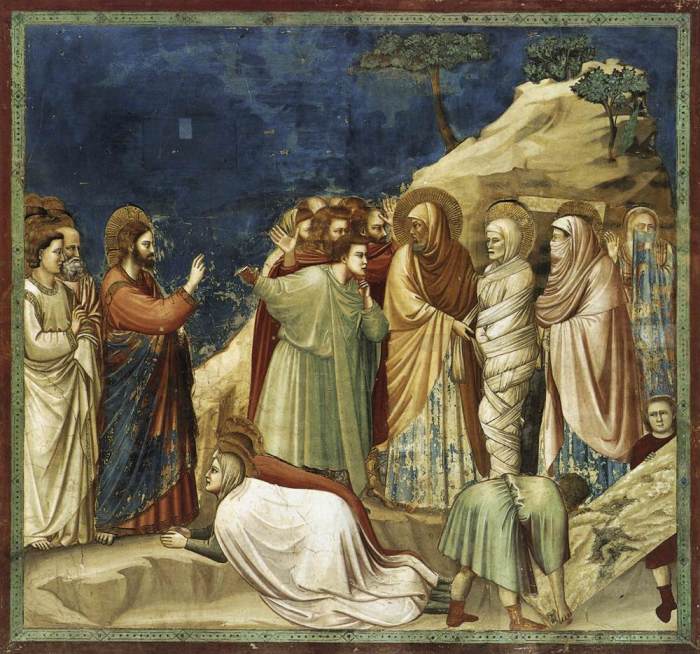
Author, pastor and spiritual director  Stephen Smith outlines the journey of spiritual transformation through the story of Lazarus in his devotional book, The Lazarus Life.  Using Lazarus as his plumb line, Smith draws parallels to our own life, a life he believes should be marked by transformation.

Smith says, “The life offered by Jesus, taught to us by Paul, and experienced by the early church, is a life of transformation.  It is deep-down change at the DNA level of our souls.  It is a life that comes only from Jesus, who identifies Himself as the only life we need.

Lazarus of course is the brother of Mary and Martha, friends of Jesus who hosted he and his disciples at their home, who listened to his teachings and watched his miraculous acts of healing and power.

In the story Lazarus falls ill, so ill that Mary and Martha believe the only way to save him is to send for Jesus, who they know from personal experience as a healer.  As their friend, surely he will come.  But Jesus doesn’t come right away.  He lingers on where he is at and Lazarus dies.

Days later and after Lazarus has been in the grave four days, Jesus finally comes.  Reading the story from our perch in history, we know what comes next.

Jesus, once more deeply moved, came to the tomb. It was a cave with a stone laid across the entrance.  “Take away the stone,” he said.

“But, Lord,” said Martha, the sister of the dead man, “by this time there is a bad odor, for he has been there four days.”

Then Jesus said, “Did I not tell you that if you believe, you will see the glory of God?”

So they took away the stone. Then Jesus looked up and said, “Father, I thank you that you have heard me.  I knew that you always hear me, but I said this for the benefit of the people standing here, that they may believe that you sent me.”

When he had said this, Jesus called in a loud voice, “Lazarus, come out!”  The dead man came out, his hands and feet wrapped with strips of linen, and a cloth around his face.

Jesus said to them, “Take off the grave clothes and let him go.”

Through Lazarus’ journey from death to life, Smith introduces the reader to the idea of spiritual transformation.  By leading us into the drama of this particular Biblical narrative, The Lazarus Life acts as a guide that will help readers like me to understand what spiritual transformation might look like and what we might need to do in order to enter into it.

Smith breaks Lazarus’ story up into different stages of the journey.  These of course are not hard and fast stages, but rather a way to talk about the sometimes messy work of transformation.  It made it possible for me to read a chapter a day and to pull from each chapter helpful ideas and insights to think about and meditate on.

It also allowed me to sink into the Lazarus story, to slow down and watch the plot unfold and put myself in the place of the on lookers, of Mary and Martha and of Lazarus.

This proved incredibly helpful as I have always read the story knowing the ending.  This robs the story of much of it’s power.

  • Mary and Martha must have faced severe disillusionment, discouragement and fear.
  • Lazarus died.  His body had begun to rot and as he stepped out of the grave, the stench of death must of stepped out with him.
  • After Lazarus had been raised, the Jews began plotting his death.

Transformation isn’t always pretty and it doesn’t always lead to a life of ease and tranquility.  Smith reminds us that “authentic transformation is always messier than we expect it to be.”

Transformation is rarely easy, but in the end, it is always good and it is always best for us and leads to the life of abundance that Jesus promises.  Stephen Smith makes that fact abundantly clear and offers a helpful guide on the journey in The Lazarus Life.

A Few Quotes From The Book

Waiting on Jesus is not a passive act.  Waiting on Jesus is soul work.  As we wait, we relinquish control, surrender our wills, give up our false hopes, and realize that if anything is going to happen at all, it will have to be  God’s doing.

Here’s a simple truth: God can use any circumstance, any tragedy, any wronged heart as an instrument for our transformation.  No tomb is dark enough, no situation hard enough, no life broken enough that God cannot use it as fodder for the fire of transformation.

The rhythm of Jesus’ life is the rhythm of a transformed life:  a time of activity followed by a time of reflection.  Both are vitally needed.

We get one life but many opportunities in this one life to get it right.  To live a transformed life is a life-long privilege.

Hey, those links to the book above are affiliate links.  They don’t change the price for you if you’d like to pick up a copy, but I’ll make about 7% from Amazon.  If you are in the Freeman, South Dakota area of course you can borrow my copy.  Buy The Lazarus Life.

image

The Fogs of Life

My morning respite.

Sunday morning I awoke to the train rolling through the small town of Dolton just a half mile south of the farm with persistent warning blasts from its horn.  It was 4: 30 am and I drifted out of a dream and into the living room to peer into the darkness in search of understanding.  The engineer kept blasting the horn, again and again as if the cows had gotten out and wandered onto the tracks.  But it was not cows he was worried about, it was fog, a thick, wet fog that clung to the earth and shrouded vision in its grasp.

A few hours later and after a bit more sleep, I worked my way into my morning routine.

  • Start the coffee to brewing.
  • Drink a class of water.
  • Make a half of a peanut butter and jelly sandwich for first breakfast.
  • Grab my satchel with my books and journal and head to the Adirondack chair in the flower garden.

As I stumbled out the back door, coffee in hand, I was met by the soaking blanket of fog that had earlier slowed the train.  I was glad I’d thought to bring a towel for the chair was soaked with beads of fog formed moisture.

I settled into the morning, pulled my book and journal from my bag and set back to take in the view with a sip of hot coffee.  I stared into the cloud of white around me, discerning naught but the outline of the machine shed on the far side of the yard.  It sat a ghostly apparition in the distance beyond which nothing could be seen.

The land was hung in white darkness.

Life has seemed shrouded in fog as of late.  Many decisions yet to be made remain unclear, remain unanswered.  I see shapes of what the future might hold, but nothing is clear.  Our future is a shadowy outline yet to be defined completely.

The farm wrapped in fog.

The fog of life leaves me at times worrying if I’ll find my way.  I can move forward, one gingerly step at a time, always checking to see if I’ll recognize landmarks that will lead me further, or I can wait.  I can sit and wait and be still until the fog lifts because, fog always lifts.

One gift of the waiting is the seeing of new things, things unseen when moving quickly through life.  The yard Sunday morning was pockmarked with white spider webs coated in a sheen of fog induced dew.  They were there the day before and perhaps I’d crushed more than a few traipsing back and forth across the burned up lawn, but I’d never noticed them.  The fog, both by stopping me in my tracks and by accentuating their presence, unveiled them.

One of many such spider webs.

How About You?

Sometimes in the fogs of life we must set out as best we can and work our way toward an ethereal destination that only becomes clear as we move forward.  At other times, we need only to rest in the cloak of darkness, looking and listening for the beauty that can only be found in the waiting.  And sometimes it seems we do a bit of both.

That is where I find myself now.

How about you?  What has life surprised you with when you’ve set out into the fog or when you have waited for the fog to lift?