First Snows

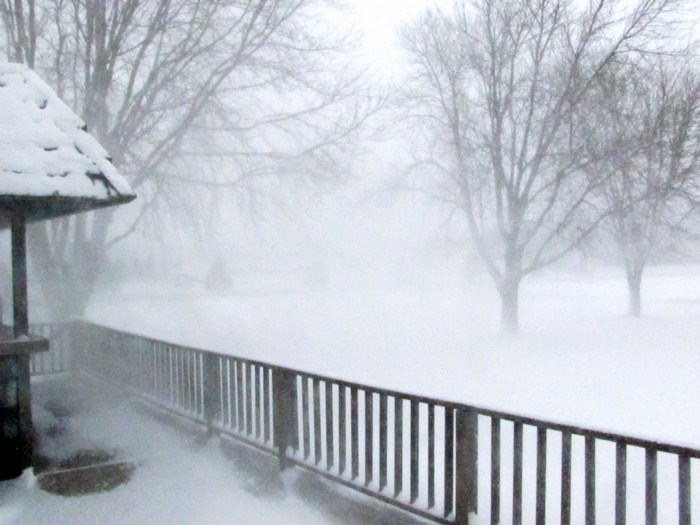
Our first blizzard in five years.

Our family have been enjoying listening to the Little House on the Prairie series as we travel in the van.

The rawness of frontier life  lies in stark contrast to our comfortable and well maintained life in the 21st century.

For Laura Ingalls and her family, a winter storm meant the cold cruelty of hard work and suffering, offset only by evenings gathered around the glowing cookstove and the sound of Pa’s violin.

For us, the first snowstorm of the year, a certified blizzard in itself that kept us home from church today and which has cut off our view of the football stadium across the road from our living room window, has meant a quiet afternoon listening to stories on the iPod, drinking hot chocolate and jaunts outside with the kids to pretend we are arctic explores.

I love winter for this reason.

It slows life and by coming in, we are able to slow down and come out.  Ideas from the long months of business begin to settle, to sift themselves into the spaces between activity and to come alive for the first time.  It is as Annie Dillard writes about in her winterish book, Pilgrim at Tinker Creek.  

It was also Annie Dillard who reminds us that:

How we spend our days is, of course, how we spend our lives.

Today, I’m spending mine with my kids – inside and out, with a few cups of hot apple cider, a visit to the nursing home to visit my wife’s grandfather, with games and stories and a bit more.

Small Town Realities

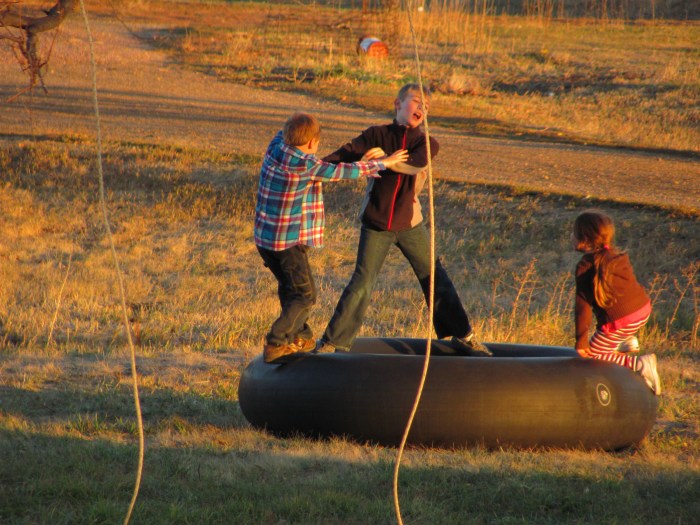
Small town fun:  Using a combine inner-tube as a trampoline.
Small town fun: Using a combine inner-tube as a trampoline.

I live in Freeman.

It is a rural town of just over 1,000 fine folks located in the southeast corner of the state of South Dakota.

Freeman is a fine place with a teeming main street, two schools, a museum and plenty to do.

But it’s not Disney World.  It’s not Chicago.  It’s not the Rocky Mountains.

Here in our corner of the prairie, we have a matrix for how much friends from other parts of the country love us:

  1. If they don’t  visit, they probably still love us.
  2. If they do visit, they are crazy about us because no one comes to South Dakota.

If they take pains to travel to tiny Freeman in the southeast corner of South Dakota, they have come to see us – there is nothing else to see.

If you live in New York or California or anywhere else really, well, they may just be stopping by on their vacation to the beach.  There may be mixed motives.

You may just be a free motel. 

But if someone comes to visit us, they aren’t on vacation.

We are their destination.

And we feel loved.

Small town realities.

Would You Buy Don Miller’s New Book for $30.00?

I was reading a post by Andy Traub today which did a good job of introducing his readers to Donald Miller’s newest installment, Storyline, and at the same time bringing the discussion of pricing products into the picture.

The topic of pricing would not have come up of course had Storyline not been priced at $29.99.

A 95 page paperback workbook for thirty bucks!

I don’t want to get into whether or not Don’s new book is worth $30 or not – I love Don’s writing and believe that the value to be found in the those pages is probably is worth that price, and if it changes your life, it’s probably worth a whole lot more.

But I want rather to discuss pricing.

I am an online entrepreneur.  I am working to make a living through guide sales, affiliate links, an upcoming online course and through language coaching.

In all of that, I have to set prices on my products and services.

The world would say that you price products at the maximum price that the market will bear.

So we have music CDs that sell for nearly $20.00.

We have digital products by popular bloggers selling for hundreds of dollars.

And Don Miller can sell a 95 page workbook for $30.00.  (His tribe is big enough that he could have sold it for a lot more)

Pricing is based on a premiss – make as much money as you possibly can.

It is of course not the only premiss, it is far more complicated than that.  But it is a major factor.

That is the way of the world.  That is why I saw a headline a few years ago about 3M laying off 5,000 workers when their profits were not as high as expected.  They laid off 5,000 workers and they were profitable!?!

But I get that.  It’s business.  Business as usual.

It’s just that I can’t live by the premiss that the goal is to make as much money as I can.

First it doesn’t resonate with my sense of propriety.  Asking what is going to make the most money is not the right question for me.   Asking instead, What is the proper price for me and for my customers.

Second, I guess as someone who reads the Bible and has decided to believe it to be true and to both obey Jesus’s teachings and to follow the examples that I find in the pages, I can’t seem to get past 2 Corinthians 8: 13-15:

Our desire is not that others might be relieved while you are hard pressed, but that there might be equality.  At the present time your plenty will supply what they need, so that in turn their plenty will supply what you need. The goal is equality, as it is written: “The one who gathered much did not have too much, and the one who gathered little did not have too little.”

Again in the 30th chapter of Proverbs this is reiterated, albeit a bit differently.

“Two things I ask of you, Lord;
do not refuse me before I die:
 Keep falsehood and lies far from me;
give me neither poverty nor riches,
but give me only my daily bread.
 Otherwise, I may have too much and disown you
and say, ‘Who is the Lord?’
Or I may become poor and steal,
and so dishonor the name of my God.

I guess my struggle is that our pricing structures in some way reflect our hearts.  And I want my pricing to reflect a Biblical heart.

And boy is it a struggle.

Everyone always says that Christians’ lives should look different than the world.  I guess I had always missed the small print – except when it comes to making money.

I remember reading a biography of Rich Mullins.  He was a hugely popular Christian recording artist in the 90’s.  Superstar huge.  And yet amidst his fame (and fortune, but more on that  later) he moved to an Indian reservation in Arizona where he taught music to Native American Kids while living in a trailer house.

When asked about how much money he made from his music by a journalist, Rich responded truthfully that he didn’t know.  You see Rich had his studio send all of his checks to his church and had the church pay him a salary that was at the time, around $24,000 a year.  (Read about it here)

Rich, like my Bible reading habit, challenge me.

I don’t in any way want to walk in condemnation of others and how they price their products.  I price my products too and if I were to condemn, then the proverbial log is in my eye.

I guess I just want to see a conversation take place, to see some reflection and, to get some help in understanding it all myself.  I am trying to walk this out well and proper and in good conscience.

Rich Mullins and the Bible keep me uncomfortable though.  So uncomfortable that I do things like give all of the proceeds of my guide sales this month to Blood:Water Mission to fight HIV/AIDS in sub-Saharan Africa.  [read about it now]

Andy, in the blog post that prompted this exploration, ended his post by asking, “Would you spend $30.00 on a book?”

And for me it led me to my own question, “Would I charge $30.00 for a book?”

If you are looking for a great Christmas present for someone you know, check out Rich Mullins: A Devotional Biography: An Arrow Pointing Toward Heaven (That is an affiliate link).

Wandering and Wondering

I began this blog in a rocket launch flame of glory back in June and did well to break through the stratosphere in the first three months, publishing three to four weekly posts.

But then I got lost in space.

I’ve wandered a bit as I worked to gain focus on other aspects of life – namely resettling after four and a half years living in Turkey and working to get my income generating corners of the web up and running in a way that pays the bills.

Well we aren’t really resettled yet and, while the other sites are not yet paying all of the bills, they are beginning to pay more of them.

Thankfully, our bills are pretty minimal right now.

Anyway, I’d like to work at writing more here again.  A little every day perhaps.  A few times a week if I’m doing well.

We’ll see how it goes and I hope I’ll keep up with it all.  I’ll do my best because I know that:

Good intentions are fodder on a field of broken dreams.

If you are on Twitter, you can tweet that.

Friday Poems: Technology

We have been in the process of moving into our new home in Freeman, South Dakota and in that process have unpacked countless boxes and bags, some of which were packed over five years ago.  It has led to more than a few interesting discoveries, one of which was a yellow piece of legal paper with a poem scribbled on it.

I believe I wrote it sometime between 2002 and 2004 while we were living in the Twin Cities.  I find it interesting as it reflects my long-standing and nuanced distrust of technology and innovation.  It is the tension I still live in and in fact, live in now more than ever as I work to craft a business based on technology and the innovation that has given us the world-wide web in all of its fullness.

– – – – – – – – – –

It has come

    to save us from

the mundane tasks 

    of paper and pen.


Instead of letters 

    of time and of thought,

emails are sent

    and emails are caught.


Instead of visits

    within sight of a friend,

chat rooms entice us

    to a life of pretend.


Life will be better

    is the thought of the day

as technology and innovation chase us

    into the grave.

Rural Housing

Rent to own in Irene, South Dakota.

The housing markets of rural America – at least in Southeast South Dakota – are quite different from those of our urban neighbors.

Net out-migration does that to a community.  The rules change.

Last week for example, in the neighboring community of Marion,  a three bedroom home with an attached two car garage and a large yard sold on auction for $17,000.  You read that right.

$17,000.

With no one interested in purchasing the home, it was probably picked up by a local who will turn it into a rental property.

Folks here sell their homes on auction because then at least then they can sell it.  Putting a sign in the yard, putting adverts in the paper and finding a real estate agent in no way guarantee a home will sell.

There are any number of homes in Freeman that are for sale and have been for several years now.  Most are quite nice and compared to city prices, relatively inexpensive.  But for our rural area, with so few people looking for a house to buy, they set empty.

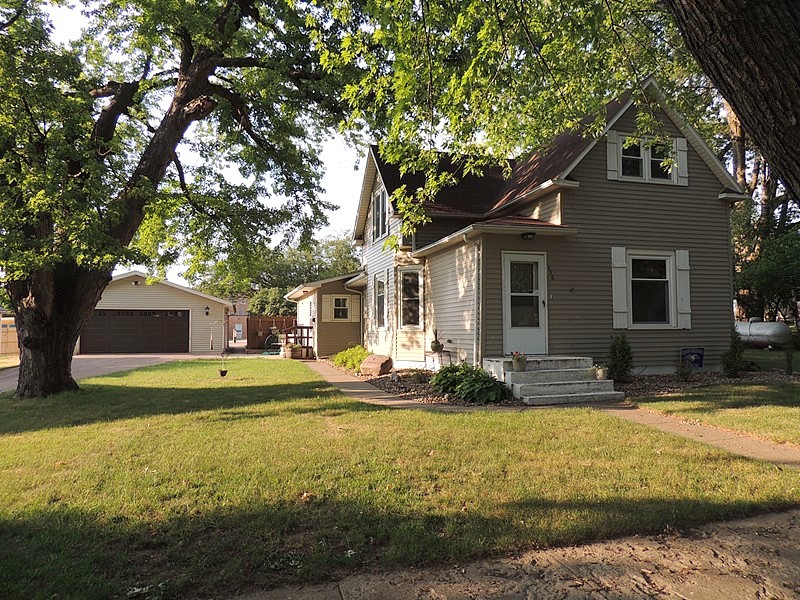
For us, we continue to look for our own home to buy or rent here in Freeman or the surrounding area.  For now, by the kindness of friends and the goodness of God, we have a beautiful home which we are house sitting.

It is a major blessing and gives us a few months to discern what our next step will be.

What has been your rural housing experience?

image

Propriety and Personal Economics

I read a chapter from Wendell Berry’s book Life is a Miracle last week that has set me to thinking about the questions we ask ourselves when endeavoring to live a “successful” life and specifically when we think in terms of personal economics.

Berry’s second chapter, Propriety, is no walk in the park, but with the patience to read and possibly to re-read certain sections, I stumbled into a deeper understanding of an issue I’ve long wondered about and questioned.  It is also not directly written toward the idea of personal economy but is much larger in scope taking in technology, innovation and especially, science.  From it however, I’ve found new insight and begun to ask new questions.

It seems that modern American ideals of personal economics are driven by two main questions:

  1. How much do I make? (the goal being to make more and more)
  2. How much does a service or product cost me? (the goal being to pay as little as possible)

These are the two questions that drive personal economics for most with the goal being to earn more money – preferably a lot more – than is spent.  Money can then be saved or spent however one wants which most believe leads to personal happiness.

But this, even as I have acquiesced to it in my own life, has always bothered me.  It seems a short-sighted and somewhat selfish way to live that eventually comes back to haunt us all.

We have bought into the whole notion of upward mobility and the American dream without stopping to consider the ramifications.  We have lived for the pursuit of individual happiness above all else.

How does this work out in life?

  • We drive thirty miles to shop for our groceries where it is “cheaper” rather than getting our groceries from our local grocery store.
  • Our farms get bigger and bigger so we can grow more and more and we no longer have any neighbors.
  • We order online from the cheapest distributer rather than from a local merchant.

And of course in rural America we are paying a terrible price for our reliance on these two questions, these two bastions of capitalism.

  • Our grocery stores are closing down.
  • Our schools are closing.
  • Our churches are closing.
  • Our towns are dying.

Please don’t get me wrong.  I am not against capitalism – I think it is perhaps our best system to live within as far as economics go.  But capitalism based only on t the two goals of making more money and paying less money will always lead to the breakdown of communities.

And that is why, as Berry asserts, a third question must be added and that is the question of propriety.

Is it proper?  Is it appropriate?  Is it good for me and for the community?

Without this question guiding us we will always strive for more rather than enough.  I may save a few dollars paying online, but what am I loosing?

A few months back I stumbled upon a journal from one of the local farmers around our area in Southeast South Dakota.  In it she recorded a bit of each day in that year – 1968.

It snowed a lot that year and so snow removal sets the theme for much of the early months.  The drakes were butchered regularly.  Preparations were made for planting.  Gardens were tended. Doctors were visited.  All the normal mundane things that have happened on farms from time immemorial and many of which still happen today were recorded in her journal.

But there was one recurring entry that impacted me more than any other.  And it went like this:

  • We went to visit the Smith family tonight.  Had a wonderful time.
  • The James family visited Sunday afternoon.
  • Mrs. Frank Thomas came with a pie.  We had a nice visit.

I’ve changed the names to protect the innocent but the theme persisted all year long.  People were coming to visit and going to visit on a weekly basis.

The idea of community was alive and well.

And it is something that, at least in our rural communities, is being lost.

There are many factors we could blame for this of course and I won’t be so naive as to say that our economic choices are the only cause.  But they are part of the cause.

When we begin to ask what is proper, what is appropriate and what is good for the community before we look only to making the most money or getting the cheapest prices, then we will begin to make the choices that will help to sustain our communities.

And that will be good for us as well.

—-

You can find Life is a Miracle at Freeman Public Library like I did, at your local bookstore or at Amazon*.

Read a great review of Life is a Miracle at Against Nothingness.

*Affiliate Link

Friday Poems: We Sit Together

My son and I back in 2006. He was two.

We sit together, you and I

Beneath a moon lit sky,

The stars above

Behold us here,

Grace in celestial eyes.

You are two, I thirty more,

Both travel toward death’s door,

My hope for you

Is nothing less

Than Christ’s eternal shore.

The sky is dark, the night is long,

All heaven sings her song,

The earth is warm,

Our time is sweet,

Enjoy this gentle calm.

And now we go, our sleep to find,

The day has been too kind,

A gentle sun,

The placid breeze,

Recollections of the mind.

Good night my son,

Good night.

October 5, 2006