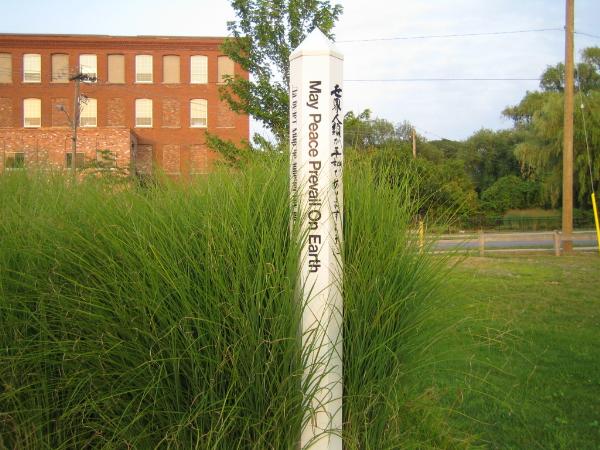
Friday Poems: Peace Pole

May peace prevail on earth

Is what we read and why we’re here.

Moce Friede Auf Erden Sein

The words again in our father’s tongue.

 .

The cool wind calls through

Rushing treetops

While leaves drop like

Golden cluster bombs

And land among the feet of children.

Only here, at our peace pole

We need not fear leaves

Falling from the sky.

We are safe.

.

Seated in a staggered

And erratic circle,

Students shiver

The cool fall shiver of October.

Soon back to school,

The shiver will be gone,

The thought of cold, evaporated.

But what of peace,

Of thoughts of peace and a world

Of fear and death and destruction

And children shivering the endless

Shiver of poverty

And walking the prosthetic limp

Of the cold remnant of someone else’s’ war?

….

Will those thoughts evaporate as well?

Will we return to the malaise of every day

And shallow talk and cheap grace?

.

Light pours down, filtered and soft,

Mingling, warming,

Guiding through the dark night

And out into the dawn.

________________

October 6, 2006

(After Friday peace service at the campus peace pole)

image

Strong Encores Always Impress

A few nights past, I was able to head into Wichita State’s Cessna Stadium for a Drum Corp International competition with my mom, uncle and sister-in-law. It has become a bit of a family tradition since my cousin Dieter marched with a corp called the Troopers for seven years.

For those not familiar with drum corp – I wasn’t until my cousin got involved – it’s a bit like marching band – on steroids, and it’s pretty amazing.  You can watch the video at the end of this post to get the full experience and if ever there is a competition near you, I’d heartily encourage you to go.  You won’t regret it.

Dieter is no longer marching but is traveling with a corp called the Cadets this year as their videographer.  It’s a great gig as he is an up and coming media guy, taking great photos and shooting some fantastic videos.  You can check out more of his stuff out at Dieter Wiselogel.

As a rookie to drum corp, I can tell the difference between the bad, the good and the great performances and you could too.  The sound, the storytelling and the shows are just different and the top corps will take your breath away.

The show we attended was no different.  The first two shows had fewer members and put forth okay performances.  There were flashes of brilliance, but nothing sustained and nothing to take your breath away.  The last four corps were great though.  The sound they produce is at times crushing in its immensity and at other times like a gentle breeze to sooth the soul.  The story they tell with the music and with the dancers is mesmerizing.  Their shows were amazing.

Dieter had the night off from shooting film and so was able to sit in the stands with us to enjoy the show.  It was interesting to sit with a professional, someone for whom drum corp is a passion and whose expertise can recognize what my eyes cannot.  He added that extra bit of insight that took my appreciation for what I was seeing up one notch.

There were a lot of takeaways from my night at the drum corp event.

The passion with which these kids pour into their summers, night after night, show after show is fun to see.  They’ll practice all day in 100 degree weather, put on a show and be out practicing again after the show in the parking lot before their bus takes them – overnight – to their next destination.  There, they’ll disembark and crawl into sleeping bags thrown down an a gym floor for a few hours of sleep before they wake up and do it all over again.

The passion of these kids is something I hope everyone can find in life, find and then ride.

But the thing that most impressed me about night was the encore.

After the last show, the Cadets, had left the field, one of the earlier acts marched back on to the field to give the audience an encore performance while the judges tabulated the scores.  I leaned over to Dieter and asked if the corps enjoyed giving the encore.  They had been practicing all day in 100 degree weather. They had slept on a high school gym floor the night before.  They were tired, stinky and had already given a truly amazing performance.  Dieter confirmed what I would expect – most corps dread their turn for the encore.

And so as the Madison Scouts marched back out and took their places in front of the grandstand for what would be our last memory of the evening, my expectations were low.  The drum and bugle corp formed a half circle behind the larger, stationary percussion instruments and their drum major took his place in the stands so his musicians could see him.

But then it happened.

Magic.

The drum major raised his hands and they began.  They poured everything out.  They had fun.  They put forth big, amazing brass sounds that blew the crowd away.  For ten minutes they put on a musical spectacle that was a gift to us all. 

They didn’t need to do it. They could have packed it in. The night was already a success. The crowd had been given more than their money’s worth already, and yet the Madison Scouts gave more.

I suspect it’s the same with all the great corps.  It’s why they are great.  It’s what separates the men from the boys.

It’s the ability to dig deep and give the gift even when it’s not needed, even when it’s not expected.

And it’s what we all should aspire to as fathers and mothers, as employees and employers, as leaders and entrepreneurs and people.

It challenged me to think about how I could be like the Madison Scouts and give my best even when I am tired and want to pack it in, even when it wouldn’t be expected, even when there is no real reward in return.

It’s something I want to work on.

How have you given the gift of your best even when it wasn’t expected or needed in this last week?

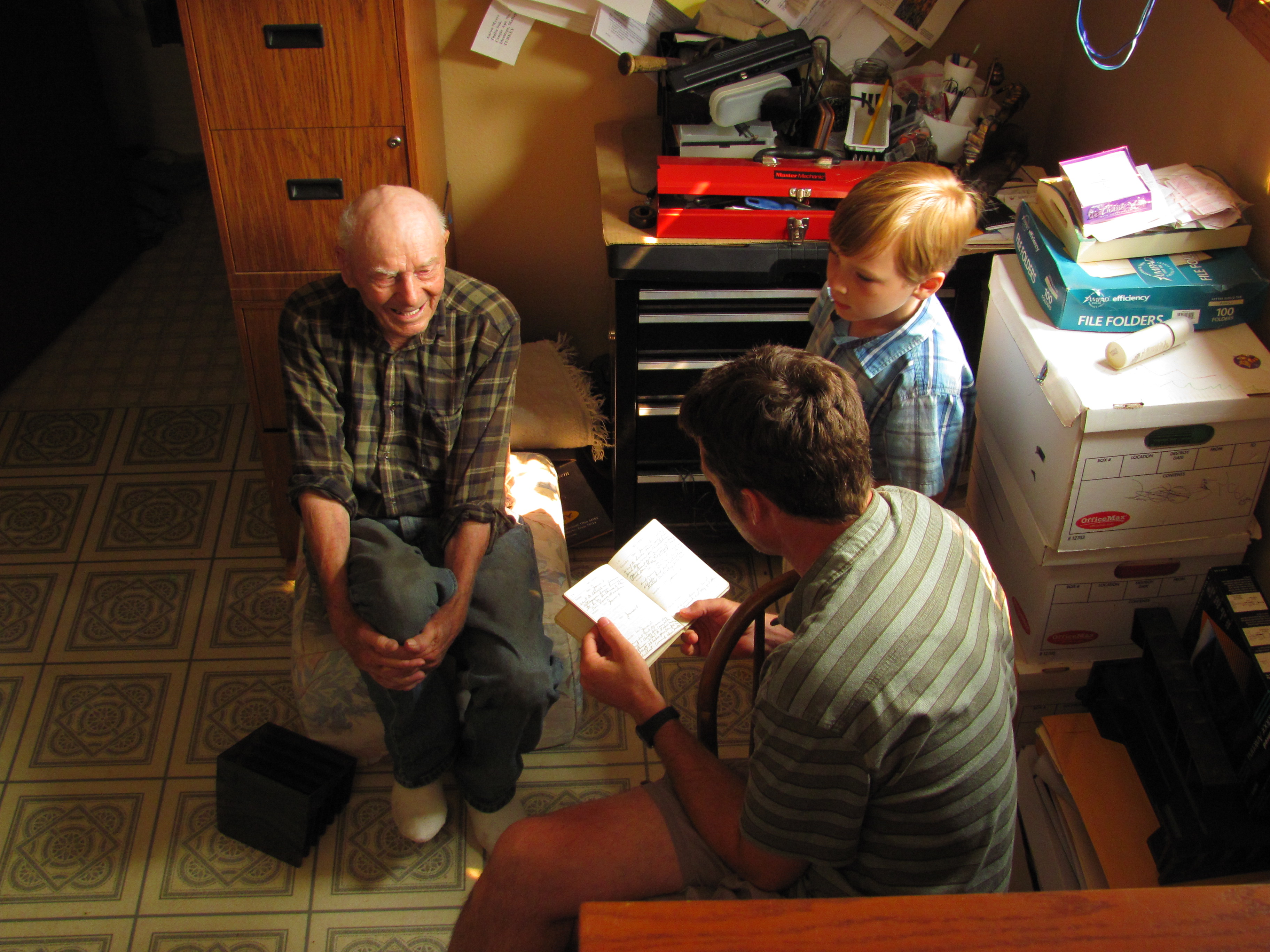
image: Dieter Wiselogel

Sir Ken Robinson Gets It

(if the video doesn’t play, you can watch it HERE)

I’ve probably watched this video four or five times now, and each time I watch, I’m inspired and encouraged.

It gives me hope.

But it also makes me want more for my kids than I think most public schools are capable of giving them.   The teachers are fantastic for the most part, but the system within which they work is too often crippling their ability to help kids flourish.

At least that is my personal experience  as a teacher of high school English in the Midwest for several years.

Sir Ken Robinson gets it.

The problem is that we are functioning in a system that was developed over 100 years ago in order to prepare kids for a world that no longer exists.  The industrial age is dead.  The old economy has gone the way (or is going) of the dinosaur.

The question then for all of us to explore is what in the old system (if any) do we keep and what needs re-inventing to prepare our kids to live in the world of tomorrow.

Any ideas?

Seasons, Expectations and Reality

Seasons come and seasons go and with each, new challenges and opportunities arise.  My family and I are in a season of transition now, of visiting family and friends and of sleeping on floors, in spare rooms and hopefully, for a few nights at least, under the stars.

Mostly this season of transition has been really good.  After four years in Turkey, it is wonderful to spend time with family, to watch the cousins play for hours on end and to catch up with old friends. It has also been a time to sleep in a bit more, to read my mom’s collection of Outside Magazines and to go to baseball games, the lake or to grandmas for a few hours of conversation.

It hasn’t been a time for growing my fledgling business however.  That’s been on maintenance mode, doing just enough to keep it going and leaving me at times wondering if I should be doing more.

But it’s a season, a season I’m working to embrace and enjoy.  To do that, it seems important to bring my expectations in line with reality.  When expectations are higher than reality allows, the pain of disappointment can be great.

I once saw a demonstration that helped me understand the power of expectations to negatively affect life when they are not in line with reality.  A volunteer was called to the front of our group and a large, three feet in diameter rubber band was placed around him.  The presenter then proceeded to stretch the rubber band away from this now fear filled volunteer.  Letting go of the rubber band would have resulted in quite a painful snap.  “Our expectations,” the instructor explained, “are a lot like the rubber band. The further they are from reality, the more painful the pop is when our expectations are not met.

Not that I’ve thrown expectations out the door, but I have realized that this season will be limited in terms of the amount of time and energy that I’ll be able to focus on my online business and on writing more.

And that’s okay.

It’s okay because this season has a shelf life.  In a few weeks, our time on the road will have ended. We will be settling into the routine of life in South Dakota.  If I can keep that idea in front of me, it allows me to be more present now, to enjoy this time and focus on the relationships that are the gift of this time.  A gift I do not want to miss.

That is my desire.

Have you been able to keep your expectations in line with reality?

Friday Poems: Agnus Dei

We entered the arboretum

Under the same majesty of stars and sky.

We came to worship in song,  in fellowship.

Though I do not know you, we worshiped

The God of all creation,

The God of love and joy and hope and salvation

Together.

I came physically whole,

Healthy and when the song leader suggested standing,

I stood, raised my small son to his perch on my shoulders and praised.

You remained seated.

As we sang, as we worshiped in spirit and in truth,

You, in your broken body and shell of the man you once were,

Leaned toward your wife,

Whispered.

She nodded, stood.  

You braced yourself against her grasp now outdoing your own.

She lifted and you helped as you could,

She lifted and sang into your eyes and you into hers.

Standing for that short moment

You joined the angels in praising, 

In giving glory to the God of  creation,

To the God of heaven and earth.

And to the God of hope,

Of a new heaven and a new earth and one day,

Of a new body.  

Your very being called out to God,

“You are good, you are good, 

Though you may slay me, 

Still will I know that you are good.”

________________

 October 20, 2006

 For Maynard Yoder – Thank You!

Recycled Living in a Second Hand Year

I began to work toward a new goal yesterday.  It’s a loose goal, one I’ll set before me as an aspiration for my life rather than the hard and fast sort of goals that make me feel guilty when I miss the mark and it won’t be anywhere near a central goal in life.

It’ll be aside gig, a sort of experiment.

The Second Hand Year

For the next year, I’ll try to live without buying anything new.  This excludes food of course, and unless we stay at a slew of hotels in the coming months, toiletries as well.  We’ll see.  And it’s my little gig, not my wife or my kids.

I am an impulse buyer.  Not bad, but it’s in me.  I see something I like and want (not need) and I feel the impulse to buy it.  Too often I do.

Buying things isn’t bad of course.  There is much we need to live here in our corner of the globe – where ever that may be.  But I guess I want to live with more discipline, more intentionality in this area.

And there are other things that I want too, things that cost money.  I want to return to Turkey – four tickets cost a lot of money, money that can be saved if I’m not buying loads of other stuff.

I want to develop a business.  Robert Lewis Stevenson famously advised: “Earn a little and spend a little less.”  I’ll be earning a little for a while.  It’s growing but it’s not their yet and so I’ll need to spend a little less.

And so I want to try to buy everything second-hand, to recycle what others have discarded and use it well.  One man’s junk is another man’s treasure and in today’s world, most junk is pretty well treasure all around.

My wife is wearing a pair of $80.00 Chaco sandals that our sister-in-law found at the thrift store for $10.00.  Her last pair of Chacos are into their thirteenth year and still going.  Chacos aren’t junk.

Yesterday, we bought a 2002 Pontiac Montana minivan.  We have our reasons for buying a minivan, reasons we feel good about.  It’s a good van, clean, well taken care of and we were able to pay cash for it.  No debt is right where I want to remain.

Why

Reason 1:  It forces me to live more intentionally, to think through what I really need and grow in patience.  It’s a character thing.

Reason 2:  It allows me to depend on God and others more, to live in community, to share and to be the recipient of  God’s generosity and the sharing of friends.  (Though not the town mooch)

Reason 3: It forces me to spend less money on me so I can spend more money on the important things in life.

Reason 4:  It will allow me to complete some of my dreams – like build a straw bale home office and return to Turkey with my family.

Reason 5: It will dramatically reduce my ecological footprint.  I am a Christian environmentalist I guess.  I think the earth as on of God’s creations should be taken care of and tended, not exploited for our own pleasures.

I suppose there are other reasons.  Maybe it just gives me something to work toward within the framework of my efforts to cobble together an income back in the states.  Maybe I just like to be different.  Regardless, I’ll give it a go, do the best I can, live graciously and honestly with myself and others and have fun with it.

We’ll see how it goes.

I am in no way the first to do this.  I saw a sign recently that said, “What we call organic, our grandparent’s called food.”  It highlights the fact that there is much that has changed in the last 100 years.  Many in the “good ole days” rarely bought anything new.   And Jess over at Nothing New, Nothing Wasted spent an entire year as a family working to buy nothing new.

And with resources like Freecycle, it may be easier than I think.

Friday Poems: I Saw You Today

Written as a telling of a particular day in Istanbul, this poem is part confession, part challenge and in many ways is complicated.  Life is complicated.  Things are not always as I would wish them to be, cut and dried, black and white, easy to fit into my boxes.  This is a poem as I saw it, as I lived and experienced it.

I saw you today.

Walking past my office window,

dumpster to dumpster with drag foot strides,

I saw you, – all of you.

You two mothers pushing finds in converted baby buggies,

babies slung over bent backs,

one tugging at the slack edge of a scarlet head scarf.

Your three and four year olds –

boys in rags and broken sandals –

trailed,

sometimes behind, sometimes squirting ahead,

but always walking wearily,

wary of the ways of the back of your hand.

Harsh hand and harsher words carry them down dumpster lined streets.

The four year old’s mother

hands an unpeeled orange to his open hand,

rescued from refuse, but fails to peel it.

He makes a marvelous mess of pulp and juice before she,

the giver, the guardian,

slaps it from his greedy fingers.

On they walk,

on into their gypsy life,

their wandering life,

their hungry life,

And they disappear.

Later,

a father came.

A father with another four-year old

and another converted baby buggy

and another journey down and Istanbul street,

dumpster to dumpster, market to market,

meal to meal to find to find.

He stops the buggy behind a black Mercedes,

says stay – to the buggy and the boy,

and crosses to the waiting meal in the market trash.

The boy stays, 

lips moving – presumably for himself though I could not hear,

fingers fondling the days find.

But then a man approaches,

middle-aged and well dressed,

talking kind words to the boy, beckoning –

And the boy goes without qualm

quickly on his heels and into the next door store.

But then the father returns,

smiling at the two bruised apples and smashed orange in his hands

to find the buggy but not the boy.

I see it then.

I see how much love he harbors in his tired heart for his son.

I see it in the fear that creep into his eyes.

I see it in the terror of his movements

and in the two new  bruises the apples receive

as they hit the concrete at his broken sandals.

I see it in his hands, cupped around shouting lips –

And finally,

I see it in the flood of relief that his snack smiling son

gives him when he bolts from the store,

cookies clutched in jubilant hands.

Relief comes.

A broken heart is not broken more.

The middle-aged man walks past the two,

a silent Samaritan not letting left know what right had done.

On he walks, 

on into his Muslim life,

his secular life,

his blessed life.

And he disappears.

Later,

I walk home along the sea,

praying for this nation,

praying for grace and discernment to be salt and light.

I stop at the store,

mindlessly buying four kinds of noodles,

not knowing what we’ll make with them.

My groceries and I make our way to the tunnel where I will cross the tracks,

and there

On a concrete bench

Sit two tired teenage boys.

“Mister, we’re hungry.  Do you have any food?  Do you have any money?”

I stop, surprised.

“Would you like some noodles?”

I offer to blank stares and then add –

“You can cook them at home.”

Their look tells me they may not have a home.

“We’re hungry mister.  Do you have any money?”

“No.”

I turn and walk

And cross the tracks

And walk from them

And disappear.

But the five lira in my pocket doesn’t disappear.

And the words of Jesus don’t disappear.

“You will always have the poor among you.”

Among you.

It seems now more a command than a fact.

A command I’ve missed through the sham of  fact.

Among you.

If the poor are not among us,

Could it be we disobey?

I surely did today.

I surely did today.

(previously published at Stories from Turkey and The Everyday Language Learner)

Thoughts for the Proper Use of Technology

Last week I dove into the topic of technology with my thoughts on cell phone use.   Today, in reflection of a short article I read at The Catholic Land Movement blog, I’d like to pass on some ideas I found there for discussion.

In his article, Principles for the Proper Use of Technology, Kevin Ford offers three principles to help guide our thinking about how and when we should use technology.

Like Kevin, I have a healthy fear that we are swallowing every new thing with nary a thought to the ramifications on individual, family or community life.

This bothers me and like Kevin, I’d like to explore a bit, ask some questions and in the end, be unafraid to make significant changes if that is what is called for.

Here are Kevin’s three essential elements for the proper use of technology.

1. Technology should benefit the family and the community.

2. If a lesser technology can be used without great detriment of time, labor, or money then it should be used.

3. Technology must serve the common good.

As I reflect on my thoughts about buying a cell phone in light of these three principles, I begin to come to the conclusion – for this time at least – that we may not need to spend $150+ every month to own cell phones.

Principle two leads me to this conclusion – a lesser technology that is far cheaper is available.  We can install a land line and meet most all of our communication needs.

This of course could change as our life changes.  But it seems at least a feasible conclusion for now.

How about you?

What do you think about his three principles?  Are they helpful in guiding our use of technology?