On Reading An Essay A Day

On Reading An Essay A Day

Earlier this winter I read about Ray Bradbury’s challenge to a group of young writers, which became known as the 3/1/52 challenge. Bradbury’s suggestion was simple: read three things each day—one poem, one essay, and one short story—and write one short story every week for a year. In his original talk, Bradbury suggested doing this for 1,000 days, but the author of the article cut that back to a more manageable year. I can imagine taking up this rigorous challenge would lead to substantial improvements in a person’s writing, not to mention their thinking.

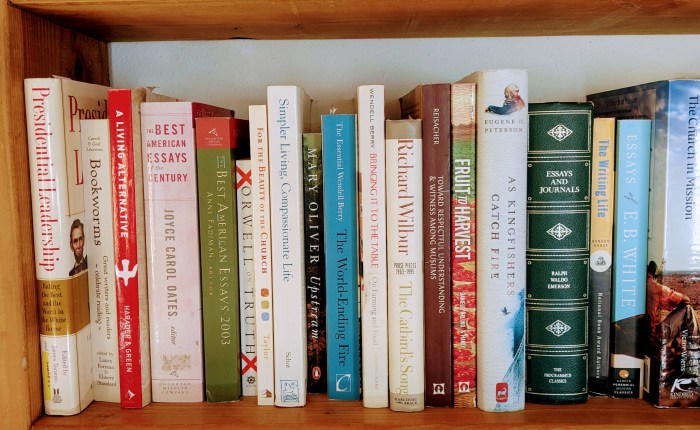
While not ready to take up the full challenge, the idea of reading one essay a day intrigued me, and as the final days of December approached, I began assembling the essay collections we own and gathering past issues of Christianity Today and Plough. On the first morning of the new year, I read my first essay: “Six Ways to Resist the Machine” by Paul Kingsworth in Plough. I’ve done the same nearly every day since. Knowing I’ll inevitably miss a day now and again, I sometimes read two essays, and as I write this, just 49 days into 2026, I’ve read 52. C.S. Lewis, in a letter to his friend Arthur Greeves, wrote, “Read everything. Read receptively. Repeat.” That’s what I’ve tried to do, and in doing so, I’ve begun to see why a daily essay has become an important part of my formation and education. As a rule, I’ve chosen essays published in collections or in publications with editorial boards.

As someone who wants to grow as a writer, communicator, and thinker, reading work that has passed under an editor’s eye has allowed me to immerse myself in excellence. Longtime New York Times editor Trish Hall wrote in Writing to Persuade, “to write well, read omnivorously. Those who read constantly tend to write coherently.” Even when I read things that don’t excite me or that I disagree with, I find beauty in the way a writer shapes a phrase, and I trust my own writing will become increasingly coherent. Saying something well is important. Saying something beautifully, a rare skill. Doing both is a gift to readers everywhere.

Another aspect I’ve grown to appreciate is regular exposure to disciplined thinking. Crafting an essay requires intellectual labor. Essays are not sound bites but carefully developed expressions of ideas. Abraham Lincoln, one of the great communicators in history, said, “what is well spoken must be yoked to what is well thought and such thought is the product of great labor.” By reading an essay a day, I’ve forced myself to labor alongside writers who have done that work. John Lewis Gaddis, writing about the study of history, says something that applies here: “Standing in the past is no sure guide to predicting the future. What it does do, though, is to prepare you for the future by expanding experience, so that you can increase your skills, your stamina, and, if all goes well, your wisdom.”

Reading widely has also exposed me to different ways of thinking. It is easy in our algorithmically driven world to find ourselves in echo chambers. In the first chapter of How to Read a Book: A Classical Guide to Intelligent Reading, Mortimer J. Adler, writing long before the Internet, observed, “the viewer of television, the listener to radio, the reader of magazines, is presented with a whole complex of elements—all the way from ingenious rhetoric to carefully selected data and statistics—to make it easy for him to “make up his own mind” with the minimum of difficulty and effort. But the packaging is often done so effectively that the viewer, listener, or reader does not make up his own mind at all. Instead he inserts a packaged opinion into his mind, somewhat like inserting a cassette into a cassette player. He then pushes a button and “plays back” the opinion whenever it seems appropriate to do so. He has performed acceptably without having had to think.” The packaging, he argues, is often so effective that we end up “playing back” opinions we never truly examined. In a sound-bite world where pundits reduce people and ideas to caricatures, reading widely serves as an inoculant against lazy thinking.

As with any curriculum, unexpected lessons appear. Two have already come into focus six weeks into this experiment. The first is that reading a daily essay is slow. Finding essays takes time. Reading them takes more, and in a world that worships hurry, it feels like a small rebellion. A TikTok culture has little patience for what is not short and catchy.

Second, Simone Weil, in her essay “Reflections on the Right Use of School Studies with a View to the Love of God,” showed me that the slow work of reading is an exercise in attention. She writes, “every time that a human being succeeds in making an effort of attention with the sole idea of increasing his grasp on truth, he acquires a greater aptitude for grasping it, even if his effort produces no visible fruit.” We live in the so-called “attention economy” where swipes and likes and infinite scroll keep the human mind in a frenzy of context shifting. Reading long form writing is a way to strengthen the attention muscle of the mind.

Another important aspect of reading a wide variety of essays is the development of empathy. In To Kill a Mockingbird, Atticus Finch famously said, “You never really understand a person until you consider things from his point of view — until you climb into his skin and walk around in it.” Reading essays by people you disagree with allows you, in a small way, to do just that. It is also an act of kindness—like sitting and listening to someone share an opinion you do not share. The second of the great commandments is to love your neighbor as yourself. Listening to those who disagree with us may be one of the most loving things we can do in an increasingly uncivil society. Reading well-written essays helps prepare us for that work.

Finally, reading an essay each day has become something of a hobby. Many are serious, but some, like E.B. White’s “Death of a Pig,” are hilarious and a pleasure to read. I could be playing video games or watching Netflix, but an essay a day has proven the better companion. It makes me smarter and gives me ideas to consider and explore.

We are always being formed by what we read, watch, and listen to; it is not neutral. Justin Whitmel Early, writing in The Common Rule, puts it this way:

We live in a world of competing types of formation, streaming like busted faucets everywhere we look. We are guaranteed to be formed in consumption unless we ruthlessly pursue curation.

Selecting the essays I read each day, along with my time in Scripture, is my effort toward that curation—toward taking responsibility for my formation. It’s not that I never watch movies or lose time online, but I have one mind and one life. It makes sense to feed that mind with what will help it grow. I hope that is what this year yields. Reading an essay a day has become less a discipline and more a way of shaping the kind of mind—and perhaps the kind of person—I hope to become.
2026 Essays I’ve Read

Are We Amusing Ourselves to Death?

Are We Amusing Ourselves to Death?

A number of years ago I was riding around the country roads of rural South Dakota near my in-laws’ farm on a four wheeler with my two young kids. We were exploring the countryside, stopping to throw rocks off of low bridges into muddy brown creeks, tracing the arc of a soaring hawk and occasionally, pulling into abandoned farm yards to poke around. There are always surprises to find, history to discover and a story to be told in a leaning barn or crumbling house.  Up one such driveway we found an abandoned home that was still standing, albeit open to the elements from every broken window and dangling door. Like so many of its kind, after the residents moved out, the house became a sort of storage shed, a place to put the things someone didn’t really want around but couldn’t bring themself to throw away. And like so many makeshift storage units, the contents were soon forgotten, overrun by rats and raccoons and the decay of time.  

As we climbed the broken down steps onto the front porch and gazed through the doorway with its screen door clinging crookedly by a single remaining hinge, we wondered about the family that had lived here. How long had they been gone?  Why did they leave? And who dumped the enormous pile of clothes and pots and pans and other household items in the middle of the floor of the kitchen. It looked like a bomb had gone off on moving day.  We stepped inside tentatively, aware that at any moment we might disturb a sleeping raccoon or some other animal that we might not really want to meet. The place was a moldy mess and yet the story of the family that had once lived there still hung in bits and pieces around us. A calendar on the wall, brittle with age, carried in its days the happenings of their weeks. A shelf with a few books destroyed by the rain that poured through a hole in the roof gave hints of their interests – gardening, faith, western novels. The colors of the carpet and curtains – had we been from an older generation – would have inevitably told of the decade they were installed.

It was mostly the tale of the decay and the kids were keen to leave before we stumbled onto something that might bite us. One last look around though revealed something worth exploring several feet from the open doorway. On top of an old heater unit in the living room sat a small, white diary. The cover was embossed with the year, 1969, and inside were page after page of the weekly doings of this family, recorded religiously in the small space for each day of the week. Sundays were nearly always spent at church in the “forenoon”, winter days were regularly accompanied by a note about the temperature – February 3rd hit a low of 12 below and was cloudy – and there were matter of fact notes about the farm chores that were completed on the particular day – January 28th – “Butchered drake (duck)”.  

It all seemed rather normal except for one thing: every week this family would either visit or receive visits from neighbors. Sometimes two and three times a week – almost always in the evenings – there were social visits being made. Community was an ever present part of this family’s life. To my modern experience this seemed odd. Not odd in the crazy uncle sort of way but rather, odd in that we just don’t live like that anymore. We text our friends a few times a week at best but we don’t spend time together, not like they did.  

Something has changed. Something drastic really.  I can find pictures and stories in the archives of any small town newspaper of Saturday nights where hundreds of neighbors showed up on Main street to visit and dance and share life together.  Boys gathered over bottles of Coca Cola to talk about the Yankees and school and girls. Ladies shared recipes and stories and prayers for their children. Men complained about the weather, argued about politics and discussed last week’s sermon. We talk of our small towns as “communities” because they truly used to be communities, places where people regularly “communed”.  We ought perhaps to find a new word to use to describe our communities.  

So what happened?  What changed that the average evening for the average American now looks like a face in front of a screen rather than a face to face? Social anthropologists could probably explain what happened with studies and stats but I think the main thing that happened was the screen itself. It started perhaps with the television but has evolved so that our innate narcissistic tendencies are now fed wall to wall entertainment. Who needs community when there is Netflix?  

A few things should be noted in this. First, we accepted this reality without a moment’s hesitation or reflection on what it might actually do to us. We were like the proverbial frog in the pot of water set to boil. We swallowed the television whole hog and then the Internet in our homes and then in our pockets and on our wrists. We occasionally lament the content – violence in the video games and porn on the smartphone in the average teen’s pocket – but we do very little about it. Second, the content is not nearly as destructive as the medium itself.  Neil Postman, in his book Amusing Ourselves to Death, warned us before the Internet had even hit the screen. 

No one listened. 

Every medium used to communicate information, every system used to accomplish a desired goal has both intended and unintended consequences. They create behaviors. They shape our lives in ways we rarely expect. By the time we recognize the problems, it’s often too late.

And so television brought entertainment into our living rooms.  It brought the news of the world into our homes. We could know about almost any topic with television and even more with the advent of the cable networks and virtually everything with Google. But while we are solving problems in our world faster than ever (a positive outcome) we are also creating problems at an alarming rate and we are increasingly, all alone.  We have traded the birthright of community for a bowl of entertainment.  We get to see every move (or Tweet) our politicians make and yet it’s all sound bites and entertainment.  Our compassion for the downtrodden refugees of war is replaced with outrage over a politician’s missteps which is forgotten with a football player’s improprieties.  And this all happens in the course of any given day.  The next day we start all over.

Television and now the Internet has changed the way we interact with our world.  We can argue over the scale of the benefits and problems that have come with that, but we must all agree that it has changed our society.  The way we communicate, the way we interact, the way we learn and grow and disagree have all been changed.  The medium, not the content, is responsible for that change.  

The system is creating us anew.

I write all of this, not to merely warn against the unintended consequences of television and the Internet. You can read Postman for that and I’d encourage you to do so soon. I certainly need to reread it for I too often find myself endlessly scrolling Facebook rather than gathering with friends and family.

I also ask these questions because if it is true that the mediums of communication and the systems of life we have adapted shape the ways in which we interact, learn, and live, then we would do well to pause and reflect on all the ways this plays into the forming of our lives in other areas.

What about the systems we’ve adopted for education at schools, and religious formation at churches has created unintended consequences?  Why do we produce so few lifelong learners through our educational systems?  Why do so many churches create consumer driven Christians?  What about the mediums and systems we’ve adapted for school and church lead to these outcomes?

These are questions that I hope our next generations will do better at reflecting on than my generation has? 

Our future probably depends on it.

Photo Credit

Waiting for The Birds

IMG_3515

We are waiting for the birds.

Last week we put out a bird feeder.  I suppose we put up a bird feeder is a more apt description as this first feeder is a small, window mounted feeder that now hangs just above our kitchen table.  So far the suction cups have held it well though we have not yet had any visitors.  It takes time though I think our neighborhood will soon bring our feathered friends for a meal.

I have been putting up bird feeder since I was sixteen.  I love the idea of having birds around and look forward to creating a thriving habitat for song birds in our yard.  When the ground thaws I’ll put a post in for another feeder or two and then put out a birdbath as well.

For now, our window feeder – plus the handfuls of seed I throw out on the ground – will have to do.  And we’ll continue to await the arrival of our first visitor.

IMG_3523