On Reading An Essay A Day

On Reading An Essay A Day

Earlier this winter I read about Ray Bradbury’s challenge to a group of young writers, which became known as the 3/1/52 challenge. Bradbury’s suggestion was simple: read three things each day—one poem, one essay, and one short story—and write one short story every week for a year. In his original talk, Bradbury suggested doing this for 1,000 days, but the author of the article cut that back to a more manageable year. I can imagine taking up this rigorous challenge would lead to substantial improvements in a person’s writing, not to mention their thinking.

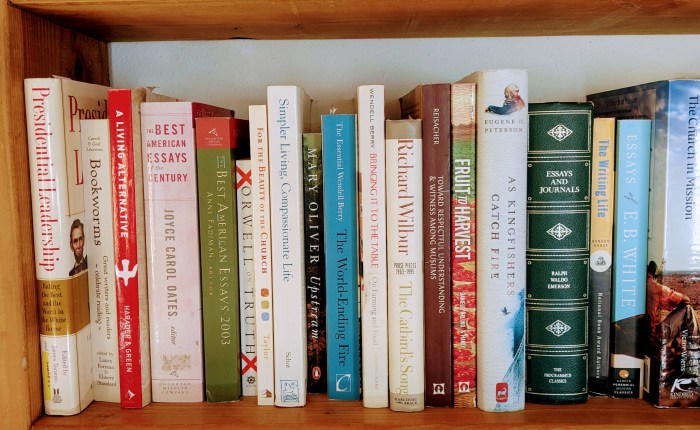
While not ready to take up the full challenge, the idea of reading one essay a day intrigued me, and as the final days of December approached, I began assembling the essay collections we own and gathering past issues of Christianity Today and Plough. On the first morning of the new year, I read my first essay: “Six Ways to Resist the Machine” by Paul Kingsworth in Plough. I’ve done the same nearly every day since. Knowing I’ll inevitably miss a day now and again, I sometimes read two essays, and as I write this, just 49 days into 2026, I’ve read 52. C.S. Lewis, in a letter to his friend Arthur Greeves, wrote, “Read everything. Read receptively. Repeat.” That’s what I’ve tried to do, and in doing so, I’ve begun to see why a daily essay has become an important part of my formation and education. As a rule, I’ve chosen essays published in collections or in publications with editorial boards.

As someone who wants to grow as a writer, communicator, and thinker, reading work that has passed under an editor’s eye has allowed me to immerse myself in excellence. Longtime New York Times editor Trish Hall wrote in Writing to Persuade, “to write well, read omnivorously. Those who read constantly tend to write coherently.” Even when I read things that don’t excite me or that I disagree with, I find beauty in the way a writer shapes a phrase, and I trust my own writing will become increasingly coherent. Saying something well is important. Saying something beautifully, a rare skill. Doing both is a gift to readers everywhere.

Another aspect I’ve grown to appreciate is regular exposure to disciplined thinking. Crafting an essay requires intellectual labor. Essays are not sound bites but carefully developed expressions of ideas. Abraham Lincoln, one of the great communicators in history, said, “what is well spoken must be yoked to what is well thought and such thought is the product of great labor.” By reading an essay a day, I’ve forced myself to labor alongside writers who have done that work. John Lewis Gaddis, writing about the study of history, says something that applies here: “Standing in the past is no sure guide to predicting the future. What it does do, though, is to prepare you for the future by expanding experience, so that you can increase your skills, your stamina, and, if all goes well, your wisdom.”

Reading widely has also exposed me to different ways of thinking. It is easy in our algorithmically driven world to find ourselves in echo chambers. In the first chapter of How to Read a Book: A Classical Guide to Intelligent Reading, Mortimer J. Adler, writing long before the Internet, observed, “the viewer of television, the listener to radio, the reader of magazines, is presented with a whole complex of elements—all the way from ingenious rhetoric to carefully selected data and statistics—to make it easy for him to “make up his own mind” with the minimum of difficulty and effort. But the packaging is often done so effectively that the viewer, listener, or reader does not make up his own mind at all. Instead he inserts a packaged opinion into his mind, somewhat like inserting a cassette into a cassette player. He then pushes a button and “plays back” the opinion whenever it seems appropriate to do so. He has performed acceptably without having had to think.” The packaging, he argues, is often so effective that we end up “playing back” opinions we never truly examined. In a sound-bite world where pundits reduce people and ideas to caricatures, reading widely serves as an inoculant against lazy thinking.

As with any curriculum, unexpected lessons appear. Two have already come into focus six weeks into this experiment. The first is that reading a daily essay is slow. Finding essays takes time. Reading them takes more, and in a world that worships hurry, it feels like a small rebellion. A TikTok culture has little patience for what is not short and catchy.

Second, Simone Weil, in her essay “Reflections on the Right Use of School Studies with a View to the Love of God,” showed me that the slow work of reading is an exercise in attention. She writes, “every time that a human being succeeds in making an effort of attention with the sole idea of increasing his grasp on truth, he acquires a greater aptitude for grasping it, even if his effort produces no visible fruit.” We live in the so-called “attention economy” where swipes and likes and infinite scroll keep the human mind in a frenzy of context shifting. Reading long form writing is a way to strengthen the attention muscle of the mind.

Another important aspect of reading a wide variety of essays is the development of empathy. In To Kill a Mockingbird, Atticus Finch famously said, “You never really understand a person until you consider things from his point of view — until you climb into his skin and walk around in it.” Reading essays by people you disagree with allows you, in a small way, to do just that. It is also an act of kindness—like sitting and listening to someone share an opinion you do not share. The second of the great commandments is to love your neighbor as yourself. Listening to those who disagree with us may be one of the most loving things we can do in an increasingly uncivil society. Reading well-written essays helps prepare us for that work.

Finally, reading an essay each day has become something of a hobby. Many are serious, but some, like E.B. White’s “Death of a Pig,” are hilarious and a pleasure to read. I could be playing video games or watching Netflix, but an essay a day has proven the better companion. It makes me smarter and gives me ideas to consider and explore.

We are always being formed by what we read, watch, and listen to; it is not neutral. Justin Whitmel Early, writing in The Common Rule, puts it this way:

We live in a world of competing types of formation, streaming like busted faucets everywhere we look. We are guaranteed to be formed in consumption unless we ruthlessly pursue curation.

Selecting the essays I read each day, along with my time in Scripture, is my effort toward that curation—toward taking responsibility for my formation. It’s not that I never watch movies or lose time online, but I have one mind and one life. It makes sense to feed that mind with what will help it grow. I hope that is what this year yields. Reading an essay a day has become less a discipline and more a way of shaping the kind of mind—and perhaps the kind of person—I hope to become.

2026 Essays I’ve Read

Brainwashing Ourselves Into Incivility . . .  And A Way Out

Brainwashing Ourselves Into Incivility . . .  And A Way Out

A person’s worldview, the lens through which they make sense of the world, was historically shaped by one’s immediate environment; the family and community, religious institutions and local schools, neighbors and friends. Families, communities and local influences were in turn shaped by regional factors and those regions were situated in a larger nation or people group. Thought leaders of course produced articles and books filled with new ideas that found their way into the shaping of thought so that worldviews grew and changed bit by bit and occasionally, with the publication of a pamphlet like Thomas Paine’s Common Sense, quite quickly. Something like Common Sense could influence and shape worldviews with unprecedented and powerful potency. Even these more powerful transformative factors however were received and discerned within the conversations and dialogue of local communities.

This all began to change with the radio and then the television and more recently the Internet which each brought abundant news and ideas from all corners of the world devoid of any local context. Radio and television were limited and so most of the stations we watched or listened to needed to necessarily find a middle ground of discourse and thought. This began to change with cable television and the rise of ideologically driven talk radio but went into warp speed with the advent of the Internet. Now there is an ideological corner of the Internet for everyone and we are no longer being shaped by the conversations and debates we have with people we know and trust but rather from a talking head we’ll never meet. With cable news to feed us our ideologies and Netflix to keep us entertained, there’s no need to head downtown on Saturday night to shoot the breeze with our neighbors, some who might be Democrat and others Republican, some Presbyterian and others Baptist. When that was the case, we learned to be civil, to agree to disagree and to see the other as a neighbor and a part of the community to which we belonged. 

When we allow ourselves to be formed in the ideological echo chambers of our own narrowing perspective, our neighbors become the enemy and civility turns to toxicity. In a bygone age, if our children talked about people they disagreed with disrespect and contempt, they would have been, to use a colloquial term, “taken out behind the woodshed.” When we complain about kids these days who don’t have any respect, we should look in the mirror – they sound like the talk show hosts we subject them to on the way to school and if we’re honest, they often sound a lot like us. And of course this is the problem. We’ve been brainwashed into thinking it’s all normal. Brainwashed too by locking ourselves inside echo chambers where we constrict all news to one or two tightly controlled sources. I use the term brainwashed because we all understand that is what happens in places like North Korea where the government tightly controls all media so her people only hear tightly scripted and controlled messages that promote exactly one ideology. And if we call that brainwashing then what we are doing to ourselves might aptly be called “self brainwashing.” And this seems a dangerous place to be headed as a society.

I wrote about this a bit in my article, The Danger of a Single Story . . . and a Billion Stories Too but today I want to offer a few thoughts on finding our way out of our echo chambers. This seems especially important as we head into a contentious and challenging election year and for full disclosure, I’m mostly writing to exhort and encourage those who would call Christ both Savior and Lord.

Sabbath

The Biblical word Sabbath means to cease and ceasing is an important place to begin. Sabbath of course refers to one twenty four hour period to rest and meditate on the things of the Lord, but choosing to limit intake of news in general and especially the type of hyper partisan news and opinion that so fills the Internet is an important choice we can make. The things we allow our minds to dwell upon are the things that will shape our worldview and thoughts about others. It’s important to take an honest assessment of the media sources we are listening to and watching. What are they forming in our hearts and minds? Is it fear? Stress? Contempt toward a certain group of people, people created in the image of God?  If so, we probably need to turn it off.

Feast

As we decrease the amount of media we listen to, it creates an opportunity to increase the amount of edifying and helpful content that will lead us to be better listeners, more civil in our discourse and in general, just nicer people. One thing I did last year was read through the entire New Testament during Lent. I read about four chapters a day and completed everything except Revelation before Easter. Immersing myself in the Biblical story allowed the scriptures to be the dominant voice shaping how I think about the world.

Two books I want to read this year are Crucial Conversations and How to Know a Person, both of which I’ve heard a lot about when it comes to learning again to talk with people who disagree with us. Amusing Ourselves to Death is an old book but has much to say about the power of our entertainment and media saturated lives. Another thing I’d like to read this year is a good biography of Abraham Lincoln. No president lived through more contentious times than he did and he did so with civility and without resorting to the demonization of his enemies. If anyone knows of a good biography, let me know.

Most of the podcasts I listen to are sermons by Tim Keller or podcasts focused on the great commission and missions, but I do also listen to a few political podcasts. The two I’ve turned to time and again feature a panel composed of a conservative leaning journalist, a liberal leaning journalist and the host who moderates robust conversation. I’ve appreciated being able to hear them dialogue and discuss issues they often disagree quite strenuously about but do so with a sense of respect for one another.  Left, Right And Center and Matter of Opinion are ones I listen to most often.  

A helpful source of daily news has been The Pour Over, a short summary of each day’s news with Biblical reflection. It doesn’t overwhelm with opinion framed as news and it  focuses simply on giving a summary of the day’s biggest news items. It can be listened to as a ten to fifteen minute podcast or as a daily email.

However you chose to respond, Justin Whitmel Early gives us a clear reminder of the reality we live in and a way forward when he says, “We live in a world of competing types of formation, streaming like busted faucets everywhere we look. We are guaranteed to be formed in consumption unless we ruthlessly pursue curation.” Curation – the process of selecting and organizing the content and information we read, listen to and watch is an important way forward. We have to be intentional in curating what we read, listen to and watch or we will be unintentionally formed, and we probably won’t be formed in the fruits of the spirit. What we feast on is what will form us.

image credit