
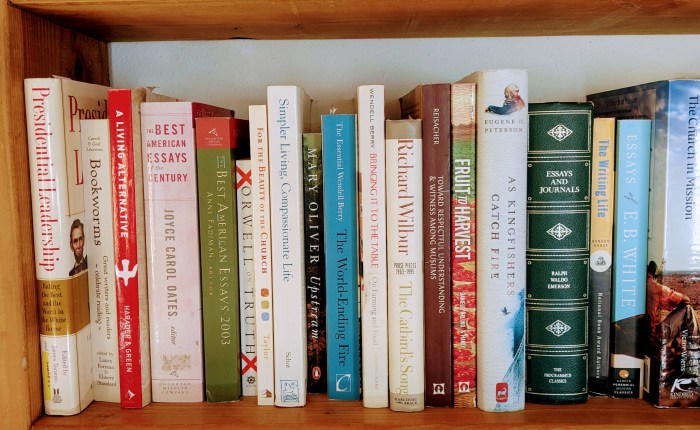
Earlier this winter I read about Ray Bradbury’s challenge to a group of young writers, which became known as the 3/1/52 challenge. Bradbury’s suggestion was simple: read three things each day—one poem, one essay, and one short story—and write one short story every week for a year. In his original talk, Bradbury suggested doing this for 1,000 days, but the author of the article cut that back to a more manageable year. I can imagine taking up this rigorous challenge would lead to substantial improvements in a person’s writing, not to mention their thinking.
While not ready to take up the full challenge, the idea of reading one essay a day intrigued me, and as the final days of December approached, I began assembling the essay collections we own and gathering past issues of Christianity Today and Plough. On the first morning of the new year, I read my first essay: “Six Ways to Resist the Machine” by Paul Kingsworth in Plough. I’ve done the same nearly every day since. Knowing I’ll inevitably miss a day now and again, I sometimes read two essays, and as I write this, just 49 days into 2026, I’ve read 52. C.S. Lewis, in a letter to his friend Arthur Greeves, wrote, “Read everything. Read receptively. Repeat.” That’s what I’ve tried to do, and in doing so, I’ve begun to see why a daily essay has become an important part of my formation and education. As a rule, I’ve chosen essays published in collections or in publications with editorial boards.
As someone who wants to grow as a writer, communicator, and thinker, reading work that has passed under an editor’s eye has allowed me to immerse myself in excellence. Longtime New York Times editor Trish Hall wrote in Writing to Persuade, “to write well, read omnivorously. Those who read constantly tend to write coherently.” Even when I read things that don’t excite me or that I disagree with, I find beauty in the way a writer shapes a phrase, and I trust my own writing will become increasingly coherent. Saying something well is important. Saying something beautifully, a rare skill. Doing both is a gift to readers everywhere.
Another aspect I’ve grown to appreciate is regular exposure to disciplined thinking. Crafting an essay requires intellectual labor. Essays are not sound bites but carefully developed expressions of ideas. Abraham Lincoln, one of the great communicators in history, said, “what is well spoken must be yoked to what is well thought and such thought is the product of great labor.” By reading an essay a day, I’ve forced myself to labor alongside writers who have done that work. John Lewis Gaddis, writing about the study of history, says something that applies here: “Standing in the past is no sure guide to predicting the future. What it does do, though, is to prepare you for the future by expanding experience, so that you can increase your skills, your stamina, and, if all goes well, your wisdom.”
Reading widely has also exposed me to different ways of thinking. It is easy in our algorithmically driven world to find ourselves in echo chambers. In the first chapter of How to Read a Book: A Classical Guide to Intelligent Reading, Mortimer J. Adler, writing long before the Internet, observed, “the viewer of television, the listener to radio, the reader of magazines, is presented with a whole complex of elements—all the way from ingenious rhetoric to carefully selected data and statistics—to make it easy for him to “make up his own mind” with the minimum of difficulty and effort. But the packaging is often done so effectively that the viewer, listener, or reader does not make up his own mind at all. Instead he inserts a packaged opinion into his mind, somewhat like inserting a cassette into a cassette player. He then pushes a button and “plays back” the opinion whenever it seems appropriate to do so. He has performed acceptably without having had to think.” The packaging, he argues, is often so effective that we end up “playing back” opinions we never truly examined. In a sound-bite world where pundits reduce people and ideas to caricatures, reading widely serves as an inoculant against lazy thinking.
As with any curriculum, unexpected lessons appear. Two have already come into focus six weeks into this experiment. The first is that reading a daily essay is slow. Finding essays takes time. Reading them takes more, and in a world that worships hurry, it feels like a small rebellion. A TikTok culture has little patience for what is not short and catchy.
Second, Simone Weil, in her essay “Reflections on the Right Use of School Studies with a View to the Love of God,” showed me that the slow work of reading is an exercise in attention. She writes, “every time that a human being succeeds in making an effort of attention with the sole idea of increasing his grasp on truth, he acquires a greater aptitude for grasping it, even if his effort produces no visible fruit.” We live in the so-called “attention economy” where swipes and likes and infinite scroll keep the human mind in a frenzy of context shifting. Reading long form writing is a way to strengthen the attention muscle of the mind.
Another important aspect of reading a wide variety of essays is the development of empathy. In To Kill a Mockingbird, Atticus Finch famously said, “You never really understand a person until you consider things from his point of view — until you climb into his skin and walk around in it.” Reading essays by people you disagree with allows you, in a small way, to do just that. It is also an act of kindness—like sitting and listening to someone share an opinion you do not share. The second of the great commandments is to love your neighbor as yourself. Listening to those who disagree with us may be one of the most loving things we can do in an increasingly uncivil society. Reading well-written essays helps prepare us for that work.
Finally, reading an essay each day has become something of a hobby. Many are serious, but some, like E.B. White’s “Death of a Pig,” are hilarious and a pleasure to read. I could be playing video games or watching Netflix, but an essay a day has proven the better companion. It makes me smarter and gives me ideas to consider and explore.
We are always being formed by what we read, watch, and listen to; it is not neutral. Justin Whitmel Early, writing in The Common Rule, puts it this way:
“We live in a world of competing types of formation, streaming like busted faucets everywhere we look. We are guaranteed to be formed in consumption unless we ruthlessly pursue curation.”
Selecting the essays I read each day, along with my time in Scripture, is my effort toward that curation—toward taking responsibility for my formation. It’s not that I never watch movies or lose time online, but I have one mind and one life. It makes sense to feed that mind with what will help it grow. I hope that is what this year yields. Reading an essay a day has become less a discipline and more a way of shaping the kind of mind—and perhaps the kind of person—I hope to become.



 Cobbled Together